



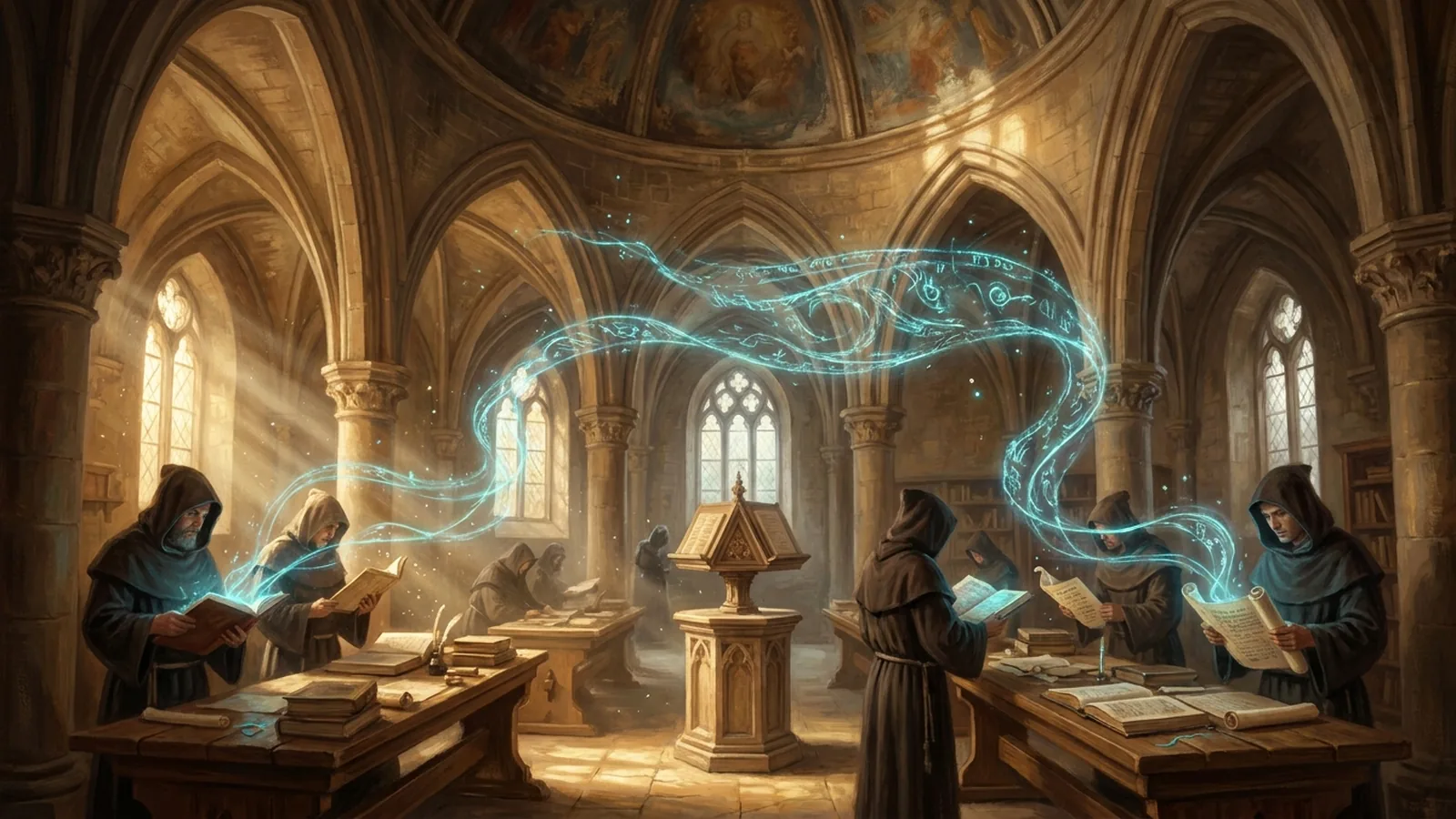
Every company sits on an asset it cannot find on its balance sheet: the accumulated judgement of the people who run it. How a deal really gets closed. Which supplier never delivers on time. The undocumented reason a process exists. The exception that the most senior engineer makes without thinking. This is the most valuable thing a business owns, and it is the least protected. It lives in heads, in inboxes, in folders nobody else can navigate. It walks out the door at 5pm and sometimes it does not come back.
Generic AI does nothing for this problem. A public chatbot knows the entire internet and nothing about your company. It can write a sonnet about your industry and cannot tell you why your second-largest client churned. The intelligence enterprises actually need is not general. It is specific, proprietary, and locked inside the organisation.
GRAL built Cognity to unlock it. Cognity is a knowledge fabric: a system that captures your company's expertise, grounds every AI answer in it, and lets autonomous agents act on it around the clock, all inside your own perimeter. This article explains what a knowledge fabric is, why retrieval quality decides everything, and how GRAL turns scattered know-how into a sovereign asset that compounds for two decades instead of one budget cycle.
What a knowledge fabric is (and is not)
The phrase gets misused, so start with what Cognity is not.
It is not a wiki. A wiki is a place humans put knowledge and then forget to update. It is not a chatbot bolted onto a public model: that gives you a confident voice with no access to your facts. It is not a vector database you rent by the month, where your most sensitive documents become someone else's training data. And it is not a one-off migration project that is stale the day it ships.
A knowledge fabric is three layers working as one system:
- Capture. A continuous pipeline that pulls knowledge out of the systems and the people where it already lives, and turns it into structured, attributed, versioned memory.
- Ground. A high-precision retrieval layer that serves the right fact, with its source, to any model or agent that asks, and refuses to answer when the fact is not there.
- Act. An agent layer that does not just answer questions but completes work, reading from the fabric and writing back to it, governed end to end.
The word "fabric" is deliberate. The value is not in any single thread. It is in the weave: the connections between a contract, the email that negotiated it, the person who signed it, and the outcome it produced. Cognity captures the threads and holds the weave.
Capture: turning tacit know-how into structured memory
Most enterprise knowledge is not written down anywhere useful. It is tacit: the pattern an expert recognises, the shortcut a veteran takes, the context that never made it into the document. The first job of Cognity is to make that knowledge explicit without asking your people to stop working and write a manual.
Capture happens on two fronts. The first is your systems. Cognity ingests from the document store, the CRM, the ticketing system, email, chat, and meeting transcripts, and it normalises what it finds into a single structured memory. The second front is your people. For the knowledge that exists only in someone's head, GRAL runs structured capture sessions that turn an expert's reasoning into reusable, attributed knowledge. This is the same mechanism we describe in our work on solving the generational succession crisis: founder expertise becomes an asset the business keeps even after the founder steps back.
Three properties make captured knowledge usable rather than just stored:
- Attribution. Every fact carries its source. Not "the policy is X" but "the policy is X, from this document, version 4, approved by this person, on this date."
- Versioning. Knowledge changes. A price list, a procedure, a contract term. The fabric keeps the history, so an answer from last March can be distinguished from the answer today.
- Structure. A captured fact knows what it relates to. The contract links to the client, the client links to the account manager, the account manager links to the renewal. The weave, again.
Grounding: why retrieval quality is the whole game
Here is the uncomfortable truth about enterprise AI: the model is rarely the bottleneck. The bottleneck is whether the model is looking at the right fact when it answers. An AI that retrieves the wrong document and writes a fluent, confident, wrong answer is more dangerous than no AI at all, because it is believed.
Grounding is the layer that decides what the model sees. Cognity uses high-precision retrieval: every answer is built from specific passages in your knowledge fabric, every passage is cited, and the model is constrained to reason only from what it was given. When the fabric does not contain the answer, the system says so and escalates. It does not improvise. This is the same precision discipline GRAL applies in MiroFish, where high-precision RAG collapses the error interval to near zero, and it is what makes the difference between a demo and a system you can put in front of a regulator.
The payoff is auditability. Because every grounded answer carries its provenance, you can always ask the question that matters in a regulated industry: why this answer, on what data, from which version of the record. That is the discipline we call the glass box, applied to knowledge itself.
Sovereignty: the fabric stays inside your perimeter
A knowledge fabric is, by definition, the most concentrated collection of a company's secrets that has ever existed in one place. Building that and then shipping it to a third-party API would be an act of strategic self-harm. So Cognity does not.
Every layer runs inside the client's perimeter. The capture pipeline, the grounded knowledge, the retrieval, and the agents that act on it all sit on infrastructure the client controls, on open models, stateless, with the logging policy the client sets. Nothing trains someone else's model. Nothing leaves the building unless the client decides it should. For financial services, healthcare, defence, and any regulated industry, this is not a preference. It is the entry ticket. We made the full argument in Private AI and European data sovereignty: the short version is that an asset you do not control is not really an asset.
Sovereignty is also what lets the asset compound. A knowledge fabric you own gets richer every quarter as more knowledge is captured and more work flows through it. A rented one is a subscription that can be repriced, deprecated, or cut off, taking two years of accumulated context with it. GRAL builds Cognity to outlast the vendor cycle, because the whole point is that the asset belongs to you.
From knowledge to action: agents on the fabric
A grounded knowledge fabric is valuable on its own. It becomes transformative when you let agents act on it. This is the third pillar of Cognity and the bridge to the rest of the GRAL platform.
Once knowledge is captured, grounded, and sovereign, an AI agent can be given a job description and pointed at the fabric the same way you would point a new hire at the company handbook. The agent reads from the fabric, completes work, logs every action, escalates what exceeds its authority, and writes results back so the next agent and the next human inherit the context. We describe this shift in depth in AI agents in 2026: the move from a chatbot that answers to a worker that does. Sentara extends the same agents to live phone calls and meetings, acting on the same fabric.
The fabric is what makes those agents safe. An agent grounded in a sovereign, attributed knowledge base cannot fabricate a reference, cannot drift onto facts that are not on record, and cannot take an action it cannot justify. Remove the fabric and you have an improviser with API access. Keep it, and you have a governed worker.
How GRAL deploys Cognity
GRAL does not sell Cognity as a download. We deploy it as an engineered system, in phases, against your actual workflows.
Phase one: capture. We map where your knowledge lives, connect the sources, and run capture sessions with the experts whose know-how is not yet written down. The output is a structured, attributed knowledge fabric inside your perimeter.
Phase two: ground. We stand up high-precision retrieval over the fabric and put it in front of your people first. Grounded, cited answers to real questions, with escalation when the fact is not on record. This is where trust is earned.
Phase three: automate. Once the fabric is trusted, we deploy agents against it, scoped to specific roles, governed end to end, augmenting your team rather than replacing it. This is delivered through FabricaAI AgentsRAG & KnowledgeCloud & DataFirmware & IoTWeb3Mobile Apps, the GRAL engineering practice that builds custom systems on the platform.
Each phase delivers value on its own, and each one makes the next safer. You are never asked to trust an autonomous agent before you have learned to trust the knowledge it stands on.
Conclusion: the asset you already own
The intelligence that runs your company already exists. It is just trapped: undocumented, scattered, and one resignation away from being lost. Cognity is GRAL's answer to that problem. Capture the knowledge before it walks out the door, ground every AI answer in it so the system can be trusted, keep it sovereign so it stays yours, and let governed agents act on it so it does work instead of just sitting in storage.
The companies that win the next decade will not be the ones with access to the best public model. Everyone will have that. They will be the ones who turned their own proprietary knowledge into a sovereign, compounding, working asset. GRAL builds that asset, and it is called Cognity.